
Infants and young children are among the most vulnerable populations in emergency settings, where disruptions to essential services, unsafe water, overcrowding and heightened stress sharply increase the risk of malnutrition, diarrhea and respiratory infections. In these contexts, breastfeeding becomes a vital life-saving practice. It provides safe, accessible and immunologically active nourishment, protecting infants even when mothers face distress, displacement or limited resources. Beyond its biological value, breastfeeding is anchored in WHO/UNICEF global normative frameworks such as the Global Strategy for Infant and Young Child Feeding and the International Code of Marketing of Breast-milk Substitutes, which emphasise the need to protect, promote and support optimal feeding practices from birth. These documents recognise the right of every mother and child to accurate information, skilled support, and protection from commercial and social practices that may undermine breastfeeding. A rights-based perspective aligns with decades of evidence demonstrating that breastfeeding contributes to infant survival, reduces infection-related morbidity, and supports maternal health by lowering the risk of postpartum hemorrhage, maternal depletion, anaemia, and stress-related vulnerability, factors that become particularly critical during crises.
Despite its protective role, emergencies frequently witness the uncontrolled distribution of breast-milk substitutes, often donated without assessment, monitoring or guidance. Such practices can be dangerous, particularly when clean water, fuel, and sanitation are insufficient to prepare formula safely. There is a need for robust preparedness systems and community infrastructure capable of safeguarding optimal infant feeding practices before, during, and after emergencies. Preparedness is therefore a crucial component of resilience.
The Operational Guidance for Infant and Young Child Feeding in Emergencies (OG-IYFE), developed through collaboration among several international agencies, including WHO and UNICEF, provides evidence-based guidance to support prevention, preparedness, and response efforts in emergency contexts. OG-IYFE aims to protect the nutritional health of infants, young children, and pregnant or breastfeeding women during crises by reducing the risks associated with inadequate feeding practices. Its recommendations are globally applicable and can be adapted to any type of emergency. In 2010, the World Health Assembly recommended that governments incorporate these guidelines into their emergency plans, emphasizing the importance of creating conditions that promote breastfeeding and, when necessary, the safe and regulated use of breast milk substitutes. This recommendation was reiterated in 2018, underscoring how timely, evidence-based support can significantly improve survival and well-being outcomes for infants and their families. To be effective, guidelines must be translated into concrete actions through technical, regulatory, and governance tools that engage a wide range of key actors: health services, local authorities, civil protection agencies, the media, associations, emergency responders, and the community. Knowledge of good nutritional practices and their consistent application must permeate at all levels of the emergency response system.
Capacity-building based on WHO/UNICEF standards, including simulation exercises, observational checklists and structured debriefings, enhances the ability of volunteers and frontline workers to make informed decisions in realistic scenarios, supporting them in protecting, promoting and supporting breastfeeding while ensuring the safe, Code-compliant management of breast-milk substitutes. This approach strengthens local systems’ capacity to respond effectively to the needs of mothers and infants during emergencies.
Within the Joint Action (JA) PreventNCD, these principles resonate strongly with the objectives of Work Package 6, which focuses on creating healthy living environments through integrated, community-based interventions across the life course. Task 6.5, dedicated to Baby-Friendly Community and Health Services, plays a strategic role in fostering environments that protect, promote and support breastfeeding and responsive caregiving. Embedding Infant Feeding in Emergencies preparedness within Task 6.5 strengthens community resilience by ensuring that local health systems and social infrastructures are equipped to safeguard infant nutrition even during crises. This directly contributes to WP6’s overarching goal of promoting health equity and preventing non-communicable diseases from the earliest stages of life, particularly among vulnerable or marginalised groups.
The dissemination of IYCF-E competencies and experiences through an online workshop further supports this ambition. By engaging stakeholders in practical, scenario-based learning, the workshop enhances awareness of infant vulnerabilities in emergencies, improves coordination among services, reinforces adherence to the Code and consolidates the role of Baby-Friendly Community infrastructures in preparedness and emergency response. This contributes to a European learning ecosystem aligned with JA PreventNCD, enabling countries to harmonise approaches and strengthen local capacity.
Through the first Task 6.5 online workshop on this topic, “Infant Feeding in Emergencies: Strengthening Baby-Friendly Communities for Resilience and Preparedness,” a dedicated space is provided to increase awareness of infant feeding challenges during emergencies and to share real experiences from countries worldwide. By offering an opportunity for discussion and reflection, the workshop helps reinforce safe, Code-compliant practices and supports the integration of IYCF-E considerations within Baby-Friendly Community approaches. In doing so, it aligns with the broader commitment to fostering a more consistent understanding and strengthening local capacity.
Overall, protecting, promoting and supporting breastfeeding in emergencies is a high-impact, equity-enhancing public health measure. Integrating IYCF-E within Baby-Friendly Communities, as envisioned in Task 6.5 of Work Package 6, ensures that resilience and infant protection become structural components of local health environments. Investing in these measures improves maternal and child health, reduces preventable morbidity and contributes to long-term prevention of non-communicable diseases across Europe.
Authors: Vincenza Di Stefano¹, Francesca Zambri¹, Anne Bergljot Bærug², Ann-Magrit Lona², Hanne Christine Mosand Bliksås², Flavia Splendore¹, Annachiara Di Nolfi¹, and Angela Giusti¹ – Coordination team of Task 6.5 “Baby Friendly Community & Health Services” of the Joint Action PreventNCD.
¹ Italian National Institute of Health
² Norwegian Directorate of Health
References
- Baerug A, Langsrud Ø, Løland BF, Tufte E, Tylleskär T, Fretheim A. Effectiveness of Baby-friendly community health services on exclusive breastfeeding and maternal satisfaction: a pragmatic trial. Matern Child Nutr. 2016 Jul;12(3):428-39. doi: 10.1111/mcn.12273. Epub 2016 Apr 8. PMID: 27062084; PMCID: PMC5071711.
- Giusti A, Zambri F. Baby-Friendly Initiatives in Italy: A Lively and Expanding Landscape. Quaderni ACP. 2025;32(6):268–271. https://doi.org/10.53141/QACP.2025.268-271eng
- Infant Feeding in Emergencies Core Group, Infant Feeding in Emergencies Operational Guidance for emergency relief staff and programme managers Version 3.0 - October 2017, Emergency Nutrition Network, 2017 https://www.ennonline.net/resource/ife/operational-guidance-infant-feeding-emergencies-og-ife-version-30-oct-2017
- Pérez-Escamilla R, Tomori C, Hernández-Cordero S, Baker P, Barros AJD, Bégin F, Chapman DJ, Grummer-Strawn LM, McCoy D, Menon P, Ribeiro Neves PA, Piwoz E, Rollins N, Victora CG, Richter L. Breastfeeding: crucially important, but increasingly challenged in a market-driven world. Lancet. 2023 Feb 11;401(10375):472-485. doi: 10.1016/S0140-6736(22)01932-8. https://www.thelancet.com/journals/lancet/article/PIIS0140-6736(22)01932-8/fulltext
- United Nations Children’s Fund (UNICEF). UNICEF Guidance on the procurement and use of breastmilk substitutes in humanitarian settings Version 2.0. New York: United Nations Children’s Fund; 2021.
- World Health Organization and United Nations Children’s Fund, Global Strategy for Infant and Young Child Feeding, WHO 2003.
- World Health Organization. International Code of Marketing of Breastmilk Substitutes. Geneva: World Health Organization; 1981. https://www.who.int/publications/i/item/9241541601
Related event
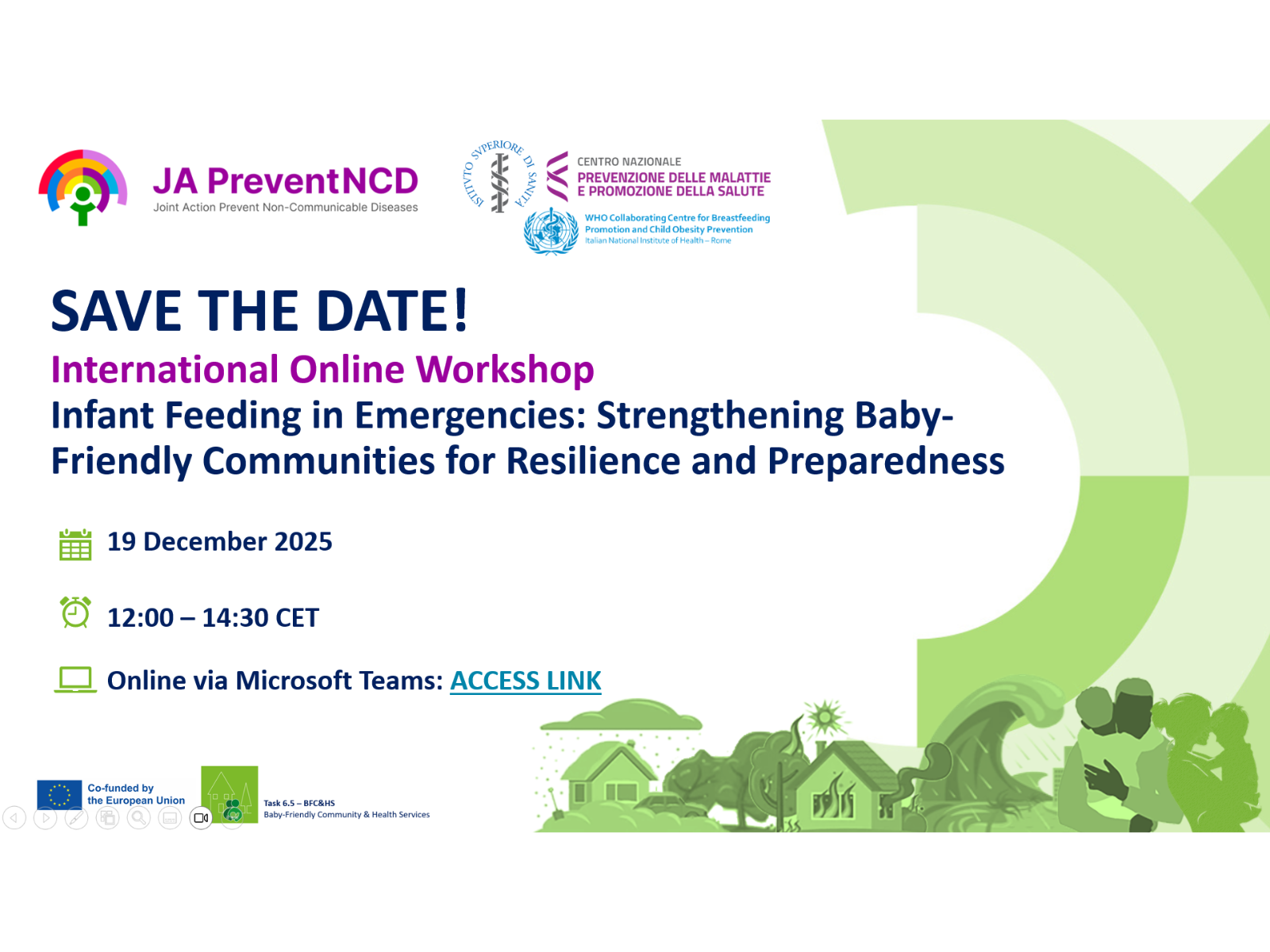
Infant Feeding in Emergencies: Strengthening Baby-Friendly Communities for Resilience and Preparedness
19.12.2025 · 12:00–14:30 CET
International online workshop exploring how countries and communities can strengthen preparedness and response for infant and young child feeding in emergencies (IYCF-E), with perspectives from WHO/Europe, PAHO and partners.